


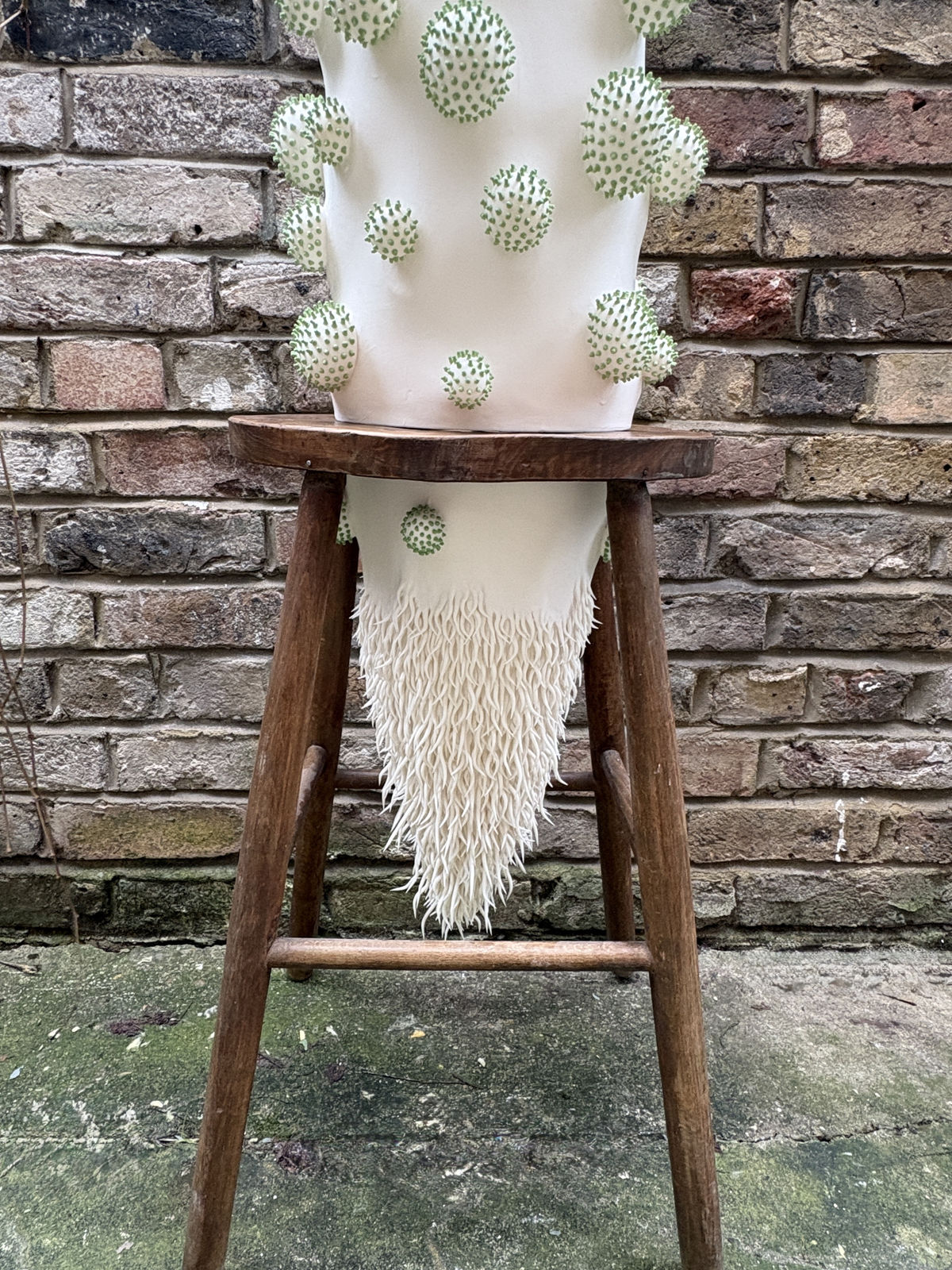

Ikuko Iwamoto
Tree, 2026
Porcelain and wooden stool
117 x 39 x 36 cm
46 x 15 3/8 x 14 1/8 in
46 x 15 3/8 x 14 1/8 in
Series: Tree
CF1694
Photo: Ikuko Iwamoto
Further images


This work reflects on how we exist within systems. Contemporary life is shaped by speed, growth, and constant production. Value is often measured by expansion. Yet nature follows a different...
This work reflects on how we exist within systems.
Contemporary life is shaped by speed, growth, and constant production. Value is often measured by expansion. Yet nature follows a different rhythm.
A tree does not grow endlessly. Its form responds to gravity, climate, and limitation. It expands only as far as balance allows.
This work considers another way of standing.
Porcelain is earth transformed by fire — resilient yet fragile. Urushi, drawn from living trees, carries time and repair. These materials demand patience. They resist immediacy.
The vertical form suggests aspiration, yet it does not assert dominance. It stands between upward movement and downward weight, holding tension rather than resolving it.
In Japanese thought, harmony (wa) is not uniformity. It is the conscious positioning of the self within a shared field. The individual does not disappear; it adjusts.
This Tree does not reject growth.
It asks what kind of growth is sustainable.
What does it mean to stand —
without exceeding the limits that sustain us?
Perhaps peace begins with that question.
Contemporary life is shaped by speed, growth, and constant production. Value is often measured by expansion. Yet nature follows a different rhythm.
A tree does not grow endlessly. Its form responds to gravity, climate, and limitation. It expands only as far as balance allows.
This work considers another way of standing.
Porcelain is earth transformed by fire — resilient yet fragile. Urushi, drawn from living trees, carries time and repair. These materials demand patience. They resist immediacy.
The vertical form suggests aspiration, yet it does not assert dominance. It stands between upward movement and downward weight, holding tension rather than resolving it.
In Japanese thought, harmony (wa) is not uniformity. It is the conscious positioning of the self within a shared field. The individual does not disappear; it adjusts.
This Tree does not reject growth.
It asks what kind of growth is sustainable.
What does it mean to stand —
without exceeding the limits that sustain us?
Perhaps peace begins with that question.
Exhibitions
Selected Exhibitions
Collect 2026, Somerset House, LondonJoin our mailing list
* denotes required fields
We will process the personal data you have supplied to communicate with you in accordance with our Privacy Policy. You can unsubscribe or change your preferences at any time by clicking the link in our emails.